If you run a lawn care business, you care about clean cuts, low downtime, route density, employee culture, and happy customers.
Robotic mowers can help with all three.
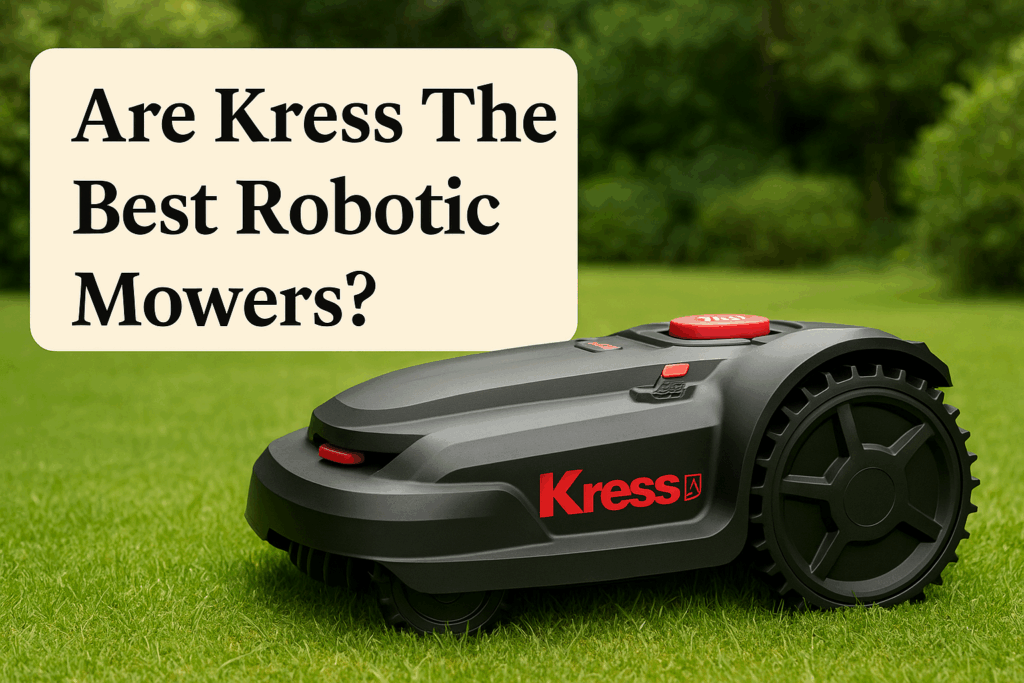
Kress is one of the biggest names in this space……especially with golf courses.
They say their robots can mow with “inch-level” (centimeter-level) accuracy and don’t need any boundary wire or a base antenna in the yard.
That’s a big promise!
Let’s look at how Kress works, why many pros like it, where it can fall short, and how it compares to other brands.
What makes Kress different?
Most wire-free robot mowers use RTK GPS.
Many brands do this by adding a small reference antenna on the customer’s property.
Kress takes a different route. Their mowers connect to Kress’s RTKn network, so you don’t install a local antenna or bury a boundary wire.
You map the lawn once in the app and the mower follows that map in neat, straight lines.
For a business, that means fast set-ups and less on-site hardware.
Kress sells several sizes.
Their residential line lists models for ¼ acre up to 1¼ acres (KR161 through KR174).
Larger “Mission Mega” units can handle bigger sites—up to 3–4½ acres (KR233) and even 6–7 acres on the KR236/KR237 range.
Prices for the residential models are typically in the ~$2,100–$3,500 range on Kress’s site.
For control, the Kress app lets you build maps, set schedules, and even manage multiple mowers at once (helpful if you place units across several customer properties).
Kress notes the app can handle up to 10 robots, and they’ve promoted a dedicated fleet app for larger operations.
Many Kress mowers include safety and “pro” touches: obstacle avoidance (OAS on some models), theft alerts/geo-tracking, IPX5 washable underbodies, and electronic cut-height control.
These are small but real time-savers when you’re running a route.
Key specs pros care about
Slope handling: Up to 40% grade on KR172/KR174 (good for most residential slopes).
Cutting capacity: KR172 is recommended up to 0.5 acres; KR174 up to ~1.2 acres. Mission Mega KR233 is recommended up to 3 acres (4.5 max with frequent cycles).
Pattern: Systematic, parallel lines (nice “stripes” look), not random bump-and-turn.
Connectivity: The robots are IoT devices with 4G for mapping, theft alerts, and updates.
Pros of choosing Kress
Fast installs, less hardware
No wire to bury and no on-site antenna to mount means you can set up a client faster and avoid repairs when someone breaks a wire or moves a base pole.
That keeps labor low and margins healthier.
Clean, repeatable cut
Because the mower follows a planned map, the lawn shows neat lines.
Many owners like that “freshly mowed” look every day, not just once a week.
Broad model range
You can match a mower to the property: small yards on KR161/172, bigger residential on KR174, and estates/fields on KR233/236/237.
This lets you standardize on one brand across different property sizes.
Helpful “pro” features
App control, multi-zone mapping, anti-theft tracking, and IPX5 hose-cleanable decks are business-friendly.
Less fiddling. Faster service.
Warranty that acknowledges commercial use
Kress publishes a North America warranty table showing robotic models with prosumer and commercial coverage (e.g., KR17X series: up to 3 years prosumer, 2 years commercial; details vary by series/accessories).
For a business asset, that clarity matters.
Cons and trade-offs to know
Needs reliable signal
Kress’s “no local antenna” design depends on good sky view (for satellites) and on reliable network connectivity.
Under dense tree canopies or in poor coverage areas, any RTK mower can struggle. Independent testing of several brands notes GPS/RTK limitations under heavy cover and with small debris/obstacles.
So, walk each site and check connectivity before you promise a result.
Cellular dependence
Kress models are connected IoT devices.
That’s great for updates and theft alerts……but if cellular service is weak, performance and features may suffer.
In rural pockets, you may prefer a mower that uses a local reference antenna you control on-site.
Not the steepest climber
A 40% slope rating covers most suburban lawns.
But if you manage very steep or bumpy sites, some competitors (e.g., Husqvarna’s AWD commercial units) go higher on slope ratings, though they may require a reference station or specific EPOS setup.
Fleet tooling still maturing
Kress promotes multi-mower control in the app and has advertised a fleet app.
If you plan to manage dozens of units, ask your dealer to demo the current fleet tools so you know how well they fit your workflow today.
How Kress compares to other wire-free options
Husqvarna Automower EPOS (and CEORA for very large areas):
Husqvarna’s “EPOS” is also RTK-based, but many installs use a local reference station on the property.
This adds a setup step and site planning (power, high mounting, and clear sky view).
Husqvarna also offers a cloud-based EPOS option, but they still outline strict placement and connectivity needs.
The upside is a long-proven pro line with high-slope AWD choices.
The trade-off is more hardware and install time.
Segway Navimow / Mammotion Luba:
These are popular “no wire” choices that rely on a local RTK antenna or GNSS receiver installed on-site.
They can work very well, but you’re responsible for placing and powering that antenna with a good sky view.
Kress’s pitch is you skip that step by using their network.
When Kress is likely the best choice for your business?
You serve many residential lawns with decent cellular coverage.
You want fast installs (no trenching wire, no base pole) and clean striping to “wow” customers.
Your average lawn is under ~1¼ acres (KR174) or you have bigger estates where KR233/KR236 fit the bill.
You value remote theft alerts, easy cleaning, and simple height adjustments to reduce truck-rolls.
When to consider another path?
The property has very dense, continuous tree cover or poor network coverage. In those cases, a mower with a local RTK antenna you place for the best sky view may be more reliable.
You need extreme slope handling (above 40%) or AWD for rough ground—look at pro units designed for that.
You plan to run large fleets and want mature, proven fleet management software on day one—ask vendors to demo their current tools.
Wrapping it Up
Is Kress “the best”?
For many lawn care businesses, yes…….on the right sites.
Kress stands out because it skips boundary wires and on-site antennas, speeds up installs, and delivers a crisp, repeatable cut across a wide range of yard sizes.
If your routes are mostly residential, with good sky and decent cellular,
Kress can save time and reduce headaches.
If you work under heavy canopy, in weak-signal areas, on very steep terrain, or you need large-fleet tools right now, compare Kress with Husqvarna’s EPOS lineup or other RTK brands that use local antennas.
Match the tool to the turf, and you’ll come out ahead.